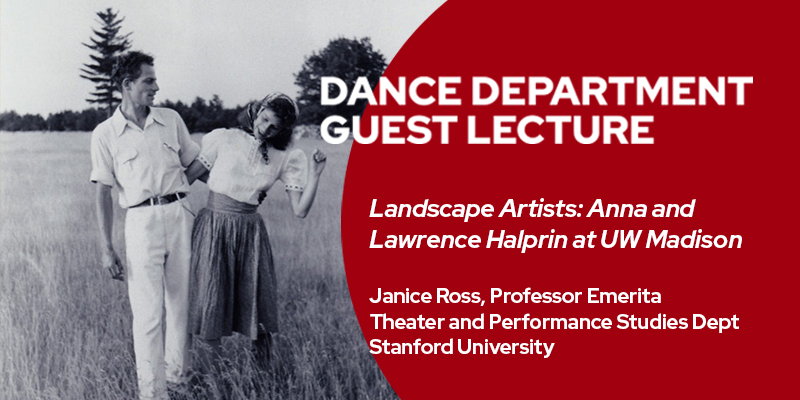
Landscape Artists: Anna and Lawrence Halprin at UW Madison
Janice Ross, Professor Emerita
Theater and Performance Studies Department, Stanford University

About Janice Ross
Janice Ross, Professor Emerita, Theatre and Performance Studies Department, Stanford University, is the author of five books including her newest, The Choreography of Environments: How the Anna and Lawrence Halprin Home Transformed Contemporary Dance and Urban Design (Oxford, 2025). Her research focuses on the politics of moving bodies. Her other books include, Like a Bomb Going Off: Leonid Yakobson and Ballet as Resistance in Soviet Russia (Yale UP, 2015/Russian edition 2024); Anna Halprin: Experience as Dance, (UC Press 2007); San Francisco Ballet at 75 (Chronicle Books 2007); and Moving Lessons: Margaret H’Doubler and The Beginning of Dance in American Education, (UW Press 2001/Second Edition UPF 2021) and she is also co-editor, with Susan Manning and Rebecca Schneider, of Futures of Dance Studies, (UW Press 2020). Her recent academic articles have dealt with topics as diverse as performance as training for citizenship among incarcerated immigrants in Italy and ballet by Jewish Orthodox women in Israel. Her awards include Guggenheim and Fulbright Fellowships; two Stanford Humanities Center Fellowships; Bogliasco Foundation Fellowship, Italy; NYU Center for Ballet and the Arts Fellowship. She received the Dean’s Award for Distinguished Teaching at Stanford and has been named an Honorary Fellow of the Jerusalem Academy of Music and Dance in Israel.
Abstract
In the months preceding U.S. involvement in World War II, UW Madison would prove a remarkable crossroads for two young students, Anna and Lawrence Halprin, whose careers would reshape the fields of Landscape Architecture and Dance. Arguing that how universities configure their disciplinary boundaries can profoundly shape the aesthetic profile of their students, Ross traces how, drawn to UW because it offered one of the few safe harbors for Jewish college students during the academic antisemitism of the 1930s, the Halprins found each other while reinforcing their cultural identity in the campus Hillel chapter, the second oldest in the nation. Creative dance and landscape architecture were nascent fields when Anna and Larry entered into them, absorbing, and then ultimately, transforming them. Part of the UW ethos they discovered was life that off campus mattered as much as on. Teaching in local public schools and performing for diverse populations was folded into Anna’s dance curriculum and Larry’s horticultural research spanned the fields and orchards of the surrounding farm communities.
A short drive away, the midcentury modern revolution of Frank Lloyd Wright’s architecture was unfolding in Spring Green, and a visit to his school at Taliesin in 1940 would prove a revelation to both Halprins. On the banks of the same Wisconsin River that wove through the prairies and forests of Taliesin, UW ecologist and conservationist Aldo Leopold, sited his famous “shack” where he drafted his land ethic in his opus, The Sand River Anthology, during this same period, while also founding the forerunner to the Dept. of Wildlife Ecology at UW. The timing was also propitious for Anna who had landed in the nation’s first dance education program headed by visionary founder Margaret H’Doubler, as that program too was in its youth.
Dance, landscape and urban design would reemerge through the work of the Halprins commingled and with a distinctly UW Madison imprint. The result would be a new civic body, socially responsive, aesthetically aggressive and anchored by an intimate understanding of social exclusion. This unique mix fueled the performance and urban design activism that became a signature of the Halprins’ work as they gave new shape to American life through transformations in postwar art and public spaces.
_____________________________
This lecture was made possible by the University of Wisconsin-Madison Dance Department with funding from the Anonymous Fund. Co-sponsors include the Center for Visual Cultures and Performance Studies, Department of Planning and Landscape Architecture, and the Mosse/Weinstein Center for Jewish Studies. Photo above: Anna and Lawrence Halprin in a Meadow, Wisconsin, 1940.
Thursday, April 9, 2026, 11:15am
Margaret H’Doubler Performance Space
Lathrop Hall
Free & open to the public